Tag: Enterprise Zones

  • Redacting Personally Identifiable Information from WOTC Supporting Documents?

    An employer submits a WOTC application, along with supporting documents, for a newly hired employee. Everything appears to be in order except that key details on the supporting documents, such as portions of the employee’s Social Security Number, date of birth, or address, have been redacted.

    A few weeks later, the response comes back. The WOTC agency is unable to verify the employee’s eligibility based on the information provided. The application is delayed, and additional follow-up is required. In some cases like this one, the credit is ultimately lost.

    The issue wasn’t eligibility. It was redaction.

    WOTC Requires Personally Identifiable Information

    In business situations, protecting personally identifiable information (PII) is essential. Redacting details such as Social Security Numbers, addresses, and other personal data is standard practice—and an important one.

    However, certain documentation requirements under the Work Opportunity Tax Credit (WOTC) program often require an exception to the redaction rule.

    To support a WOTC certification, employers are often required to provide documentation such as W-4 forms, government-issued identification, or veteran-related records. These documents frequently contain sensitive information, including Social Security Numbers, addresses, dates of birth, and, in some cases, disability-related details.

    For WOTC purposes, State Workforce Agencies use these documents to verify key elements of eligibility like age, residence, or disabled veteran status. The personal information on the document also serves to confirm that the document corresponds to the individual who is the subject of the WOTC application. If any of that information is redacted, the agency may be unable to complete that verification.

    In many cases, the PII on the document is the very information being verified—so redacting it defeats the purpose of the document itself.

    In practice, redactions can lead to delays, follow-up requests, or even denial of the tax credit if documentation cannot be properly validated. In some states, agencies may reject the document outright if it shows signs of redaction, requiring a complete, unaltered version before processing can continue.

    The Right Approach for WOTC

    WOTC always requires protecting sensitive information. But employers must also meet compliance requirements when documenting the facts of their employee’s WOTC case. Don’t file information beyond what is necessary for verification, but be aware that in some cases, if you redact information, the document might be rejected and tax credits potentially lost.

    Contact your state workforce agency to discuss its policies regarding WOTC-supporting documentation and assurances of information security. The U.S. Department of Labor publishes a handy directory that lists the name and contact information for each State WOTC Coordinator. I have found State Coordinators to be friendly and helpful when I reach out to them with questions.

    Click here: WOTC State Coordinators


    WOTC Planet does not provide tax, accounting, or legal advice. This content is for informational purposes only. Employers should consult their tax and legal advisors when evaluating changes to HR or PII handling policies.
  • Should Employers Continue WOTC Screening During a Legislative Lapse?

    A lapse in WOTC authorization naturally raises an important question for employers:

    Should we continue screening new hires if Congress has not yet renewed the WOTC program?

    That hesitation is understandable. When a federal tax credit is not currently authorized, it’s reasonable to pause and evaluate whether continuing the process makes sense. This article provides context based on the program’s history and how it has been administered during prior lapses.

    While only Congress can authorize or reauthorize the program, the consistent best practice (based on decades of precedent and agency guidance) is to continue screening and submitting applications. Continue reading to understand why.

    A Pattern That Has Repeated Over Decades

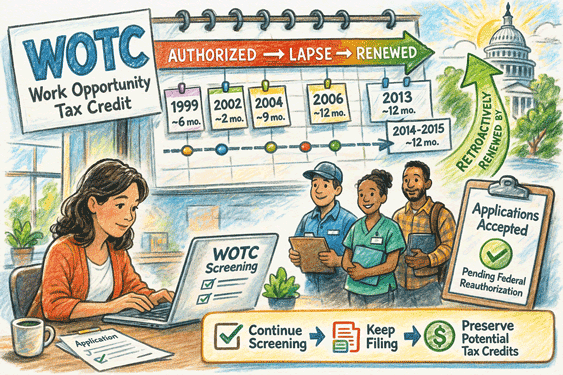
    During its 30-year history, the Work Opportunity Tax Credit (WOTC) has expired and been renewed more than a dozen times as part of the federal “tax extenders” process. In multiple instances, Congress allowed the program to lapse temporarily and later reinstated it retroactively. Those prior lapses ranged from about 2 months to more than a year.

    These have included lapses in:

    • 1999 (6 months)
    • 2002 (2 months)
    • 2004 (9 months)
    • 2006 (12 months)
    • 2013 (12 months)
    • 2014 (12 months)
    • 2015 (12 months)

    In each case, Congress reauthorized WOTC and patient employers (who continued screening and filing their applications) were rewarded with the full tax credit amount.

    From a legislative standpoint, the current lapse follows a familiar pattern.

    What Happened During Previous Lapses?

    During prior lapses, the U.S. Department of Labor instructed State Workforce Agencies (SWAs) to continue receiving WOTC applications within the required filing timeframes. While certifications could not be issued until reauthorization occurred, state agencies held the applications and issued the certifications after Congress acted.

    State agencies are communicating similar expectations today. For example, the California Employment Development Department’s WOTC web page currently states:

    Employers should continue submitting WOTC applications within [the] required timeframes. Applications with start dates of January 1, 2026, and after will be accepted and retained pending federal reauthorization.

    See EDD CA WOTC

    What Does This Mean to Employers Today?

    Historically, employers who continued screening and submitting applications during lapse periods were positioned to receive tax credits once the program was reinstated. By contrast, if screening is paused, WOTC-eligibility information is not collected, and applications can not be filed. If the program is later reauthorized, most, if not all, of the potential credits will have been lost.

    While only Congress can authorize or reauthorize the program, the consistent best practice (based on decades of precedent and agency guidance) is to continue screening and submitting applications.

    For more information, Work Opportunity Tax Credit (WOTC) Reauthorization Update: What Employers Should Know.

  • Work Opportunity Tax Credit (WOTC) Reauthorization Update: What Employers Should Know

    Congress is currently considering legislation related to the reauthorization of the federal Work Opportunity Tax Credit (WOTC). As employers may have questions about the timing and implications of this process, it is important to provide clear context and practical guidance.

    While Congress has not yet completed reauthorization, the WOTC program has historically been renewed following temporary lapses. During these periods, employers are advised to continue normal screening and filing practices.

    Why Reauthorization Happens

    The WOTC program was intentionally designed by Congress to require periodic reauthorization. Since its creation in 1996, the program has been successfully renewed more than a dozen times. In several instances, renewals occurred after short legislative gaps caused by negotiations over unrelated legislation.

    These brief hiatuses are a known feature of the program’s legislative history and do not require employers to alter their participation.

    What Employers Should Do Right Now

    During temporary reauthorization gaps, state workforce agencies instruct employers to continue screening all new hires and to submit WOTC applications on time, just as they would under normal circumstances. This ensures that eligible hires remain fully documented and properly positioned for certification once reauthorization is finalized.

    There is no recommendation to pause or modify WOTC screening or filing activity.

    WOTC Planet continues to operate as usual and is closely monitoring legislative developments. Employers will be informed as new information becomes available.

    Reauthorization — Frequently Asked Questions

    1. What does “reauthorization” mean for the WOTC program?
      The Work Opportunity Tax Credit is a federal program that Congress periodically renews through legislation. This structure has been part of the program since its creation in 1996 and is intentional. Reauthorization allows Congress to extend the program for additional years.
      .
    2. Has WOTC ever lapsed or been temporarily delayed before?
      Yes. Since 1996, WOTC has been renewed more than a dozen times. Several of those renewals occurred after brief gaps caused by broader legislative negotiations unrelated to WOTC itself. These short delays are not unusual.
      .
    3. What is the current status of WOTC reauthorization?
      Congress has not yet completed reauthorization. Historically, the WOTC program has been renewed following temporary lapses, and employers are advised to continue normal screening and filing practices during this period.
      .
    4. Should employers stop screening new hires for WOTC during this period?
      No. During temporary reauthorization gaps, state workforce agencies instruct employers to continue screening all new hires and to timely submit WOTC applications, just as they would under normal circumstances.
      .
    5. Will WOTC applications submitted during the hiatus still be valid?
      Yes. Continuing to screen and submit applications ensures that eligible hires are fully documented and properly positioned for certification once reauthorization is finalized.
      .
    6. Does this affect previously certified or claimed WOTC credits?
      No. Credits that have already been certified or claimed are not affected by the reauthorization timing.
      .
    7. What should employers do right now?
      No changes to standard WOTC procedures are recommended at this time.
      Employers should:
      • Continue screening all eligible new hires
      • Continue submitting WOTC applications within required timeframes
      • Maintain normal onboarding and documentation practices
        .
    8. How will employers be updated as Congress moves forward?
      WOTC Planet is monitoring legislative developments closely and will provide updates as new information becomes available.
      .
    9. Will WOTC Planet continue operating and supporting employers as usual during this period?
      Yes! WOTC Planet will continue normal operations without interruption. All screening, application processing, monitoring, and employer support services will proceed as usual. There are no changes to workflows, service levels, or employer responsibilities during the reauthorization period.

    What’s the outlook?

    State WOTC agencies encourage employers to continue their WOTC participation without interruption. Temporary reauthorization gaps are a known and recurring aspect of the program’s legislative history. By continuing to screen new hires and submit applications on time, employers preserve eligibility, ensuring qualifying credits are not missed once reauthorization is finalized.

    WOTC Planet will continue operating as usual and remains actively engaged in monitoring developments and supporting employers throughout this process.

    One response

  • Fresh Food Act of 2024 Would Increase the Value of WOTC for Some Grocers

    United States Representative State Cohen (Democrat from Tennessee) and Senator Jon Ossoff (Democrat from Georgia) recently introduced a bill within their respective houses, encouraging the opening of new grocery stores in “underserved areas.” The legislation would provide tax new incentives for grocers that offer consumers fresh fruits, vegetables, meat, and dairy in those areas.

    Read more: Fresh Food Act of 2024 Would Increase the Value of WOTC for Some Grocers

    The Fresh Food Act’s tax reductions are potentially three-fold. It includes a tax credit based on the business’ wholesale cost of qualifying fresh-food products, such as fruits, vegetables, meat and dairy. It would offer an additional tax incentive to grocers who source those products locally. Of most interest to us, however, is the bill’s proposal for increasing the Work Opportunity Tax Credit (WOTC).

    The WOTC tax credit amount is calculated based on an amount of qualified wages as specified by the US Tax Code. The maximum amount of wage used in that calculation varies for each employee, depending on why the employee qualified for WOTC. For most WOTC-certified employees, the maximum qualified wage is $6,000. For certain qualifying military veterans, the maximum qualified wage is $12,000, $14,000 or $24,000 — again depending on the circumstances that qualified the veteran.

    The Fresh Food Act of 2024 would increase by $1,000 the maximum qualifying first-year wage for each category. Since the tax credit is calculated as 40 percent of the qualifying first-year wage, this amounts to an increase of $400 in tax credit per qualifying hire. Of note, the increase in qualified wage would not affect WOTC Target Group I (long term family assistance recipients).

    The increased WOTC benefit would be applicable to wages paid during taxable years that begin between the dates January 1, 2025, and December 31, 2030, inclusive.

    Click here to read the text of this bill.

    For Senator Ossoff’s “one pager” summarizing the proposal, click here.

  • International Franchise Association Members Lobby for WOTC

    I am happy to repeat some good news for employers whose hiring checklist includes the Work Opportunity Tax Credit (WOTC). The International Franchise Association was recently in Washington, DC, for its 2024 annual advocacy summit. More than 300 members attended the event, during which advocates met with members of Congress to push the organization’s tax agenda.

    WOTC was one of three key tax cuts the association promoted.

    Click here to read more about the IFA’s summit in a recent article by Mary Vinnedge published by Franchise Wire.

  • Military Spouse Hiring Act – US House Sponsorship Changes Hands

    In a press release, U.S. Representative Don Beyer (D, VA) announced he has assumed primary sponsorship of the Military Spouse Hiring Act.  Former Representative Antonio Delgado (D, NY) introduced the current version of the bill but has now left the House of Representatives to serve as New York’s Lieutenant Governor.

    Read the press release here.

    The Military Spouse Hiring Act proposes an expansion of the Work Opportunity Tax Credit or WOTC. This bill would expand WOTC by adding a new target group known simply as “Qualified Military Spouse.”

    To qualify, an eligible employee must (in the usual way) be “certified . . . as being (as of the hiring date) a spouse of a member of the Armed Forces of the United States.”

    The bill does not address the meaning of “spouse,” but this term generally means an individual who is lawfully married. If passed, it will create the first WOTC target group to specifically benefit active military families.

    This new target group would provide a $2,400 tax credit.

    (more…)

  • Is Your Covid-19 Tax Refund Feeling Abandoned and Lonely?

    Don’t cry. We can make it better!

    Many employers are unaware they are eligible for special tax relief created for the covid-19 pandemic. The covid-19 Employee Retention Credit (ERC) is worth up to $26,000 per employee when a business qualifies. That means, for example, that a small business with 10 employees could qualify for up to $260,000. It sounds like a lot (and it is), but it’s also realistic.

    ERC is a fully refundable tax credit. That means if you qualify, you receive a tax refund check from the U.S. Treasury.

    There’s still hope if you didn’t claim your ERC tax credit during the pandemic (between March 2020 and December 2021). For a limited time, you can claim it retroactively as a tax refund by amending your 2020 and 2021 payroll tax returns.

    (more…)

  • United States Senators have renewed an effort to pass the Military Spouse Hiring Act, an expansion of the Work Opportunity Tax Credit or WOTC. This bill would expand WOTC by adding a new target group known simply as “Qualified Military Spouse.”

    To qualify, an eligible employee must (in the usual way) be “certified . . . as being (as of the hiring date) a spouse of a member of the Armed Forces of the United States.”

    The bill does not address the meaning of “spouse,” but this term generally means an individual who is lawfully married. If passed, it will create the first WOTC target group to specifically benefit active military families.

    This new target group would provide a $2,400 tax credit.

    (more…)

  • This month, the House Ways and Means Committee released tax proposals that may eventually be included in the massive budget reconciliation bill currently making its way through Congress. For a general summary, check out this article in the Journal of Accountancy.

    Our interest here is the proposal for a temporary expansion of the Work Opportunity Tax Credit (WOTC). The legislation replaces just a few key terms in the Internal Revenue Code, where the WOTC program is defined. Yet, the effect would be very valuable for employers who participate in the WOTC program.

    (more…)

  • IRS Extends WOTC Deadline by 10 Months for Some Eligible Employees

    Great news! The IRS has provided a new grace period extending the deadline for WOTC applications of employees who live in a federal empowerment zone.  Two WOTC target groups are affected.

    • Designated Community Residents (Group D)
    • Summer Youth Employees (Group F)

    (more…)